Finding the China Best Rubber Drive Belts Suppliers requires more than comparing prices or browsing polished catalogs. Rubber Drive Belts must match the machine, load, speed, temperature, and working environment. A belt that performs well on a warehouse conveyor may fail on a stone crusher or agricultural machine.
This guide examines Chinese manufacturers through practical sourcing criteria. These include rubber compound quality, reinforcement materials, production capacity, dimensional control, and testing procedures. Experienced buyers should request samples before placing large orders. Check belt flexibility, joint strength, surface finish, and resistance to abrasion. Small details matter. A poorly finished edge can shorten service life.
Reliable suppliers should provide clear technical data, inspection records, and traceable production information. Certifications can support credibility, but they should not replace independent verification. Factory audits, video inspections, and third-party testing may reveal weaknesses hidden in online listings. Ask about minimum order quantities, customization, packaging, lead times, and after-sales support.
No supplier is perfect. Even reputable factories may experience material delays or inconsistent batches. That is why risk assessment remains important. The strongest partnerships usually develop through repeated communication, sample testing, and honest performance feedback. This article compares suitable Chinese suppliers with a balanced perspective. It considers both their strengths and possible limitations, helping importers make a more informed decision.
A reliable rubber drive belt supplier in China stands out through measurable performance, not attractive catalogs. Experienced manufacturers can explain rubber compounds, tensile strength, abrasion resistance, and operating temperature limits clearly. They should match the belt to the pulley, load, speed, and working environment. A belt used near oil, dust, or heat needs different protection. Small details matter.
During supplier evaluation, request material specifications, test reports, sample belts, and production photographs. Traceable quality records are valuable when a shipment fails inspection. Strong suppliers also control molding temperature, belt dimensions, joint strength, and surface finish. Their engineers should discuss tolerances without hiding behind vague promises. Still, no factory gets every detail right. A sample may perform well while a large batch reveals uneven curing. Independent testing remains wise, especially for continuous industrial use.
Tips: Ask how rejected belts are handled. Check whether inspection records include batch numbers. Compare actual delivery times with promised schedules. Request a trial order before committing to volume. Clear communication helps, but written specifications protect both sides. Be careful with unusually low prices; cheaper rubber may crack sooner. A dependable supplier welcomes technical questions, admits limitations, and adjusts production when field feedback exposes a weakness.
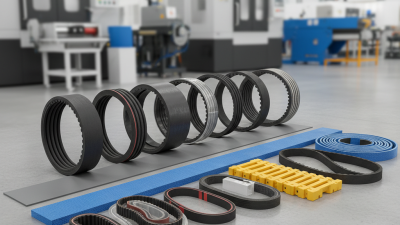
Chinese suppliers produce several key rubber drive belt types for factories, vehicles, and agricultural equipment. V-belts remain common because their wedged profile transfers torque efficiently through pulleys. Synchronous belts use molded teeth, reducing slip during timed motion. Ribbed belts offer flexible bending and quieter operation, while flat rubber belts suit high-speed transmission and conveying systems. These differences matter more than appearance.
According to Grand View Research’s 2024 Conveyor Belt Market Size report, the global conveyor belt market reached approximately USD 5.3 billion in 2023. This figure shows strong demand for durable belt systems, although conveyor belts and drive belts are not identical products. Buyers should not treat the statistic as a direct measure of drive belt sales. That distinction is easy to miss.
In practical sourcing, inspect the rubber compound, tensile cords, tooth accuracy, and temperature rating. Chloroprene rubber supports many industrial conditions, while hydrogenated nitrile rubber performs better near heat and oil. Suppliers using ISO 4184 dimensions for V-belts can simplify pulley matching. For timing belts, ISO 13050 provides useful dimensional guidance. Ask for batch test data, not only a catalog promise. I have seen small dimensional errors create visible vibration after installation. The belt looked acceptable. It still failed early. Supplier evaluation should include sample testing, hardness checks, elongation results, and pulley alignment under working load.
How to Evaluate China’s Rubber Drive Belt Manufacturers
China remains a major sourcing base for rubber drive belts, but factory size alone proves little. According to the MarketsandMarkets Conveyor Belt Market report, the sector may grow from about USD 5.6 billion in 2024 to USD 7.3 billion by 2029. This growth increases supplier choices, and confusion.
Start with material evidence. Ask for rubber compound data, tensile strength, elongation, hardness, and temperature limits. ISO 1813 provides a useful reference for antistatic and electrical properties. For cogged or synchronous belts, request tooth-shear and dimensional reports. Independent laboratory results are more reliable than a polished catalogue. I also check whether samples match mass production. They sometimes do not.
Production control matters more than impressive machinery. Review mixing records, curing temperatures, batch traceability, and final inspection procedures. The ISO Survey of Certifications reports millions of valid ISO 9001 certificates worldwide, so certification alone cannot prove technical ability. Visit the plant when possible. Look for calibrated testing equipment, clean storage, and clearly identified rejected goods. Ask about failure rates, warranty handling, and replacement lead times. According to Grand View Research’s industrial belts analysis, demand is supported by automation and machinery investment, making consistency increasingly important. Yet a supplier may still offer excellent samples and uneven later batches. That weakness deserves a written control plan, not optimistic promises.
| Evaluation Dimension | What to Compare | Practical Buyer Benchmark | Required Evidence | Applicable Standard or Test | Priority | Suggested Weight |
|---|---|---|---|---|---|---|
| Product Scope | V-belts, synchronous belts, agricultural belts, industrial belts, and custom constructions | Supplier should offer the exact belt profile, dimensions, reinforcement type, and operating temperature required by the application. | Current product catalogue, technical drawings, dimensional tolerances, application references, and sample identification labels. | ISO 4184 for classical and narrow V-belts; ISO 13050 for synchronous belts where applicable | High | 10% |
| Dimensional Control | Length, pitch, top width, belt thickness, angle, and tooth geometry | Measured dimensions should remain within the agreed drawing tolerances, with 100% identification of production lots. | Inspection plan, calibrated measuring equipment records, first-article report, and random inspection reports from recent lots. | Applicable product standard and approved technical drawing | High | 12% |
| Tensile Strength | Strength of the rubber compound and load-carrying cords | Test results should meet or exceed the agreed product specification, with no visible cord damage, delamination, or premature fracture. | Lot-based tensile test reports showing specimen preparation, test date, batch number, and recorded failure load. | ISO 37 for rubber tensile properties; ISO 283 may be relevant to belt constructions with textile reinforcement | High | 12% |
| Fatigue and Flex Life | Resistance to repeated bending, tension, and cyclic loading | Supplier should provide a documented endurance result under conditions close to the customer’s speed, pulley diameter, tension, and load. | Dynamic endurance test method, test duration or cycles, pulley dimensions, load settings, temperature, and failure criteria. | Manufacturer-approved dynamic test method supported by application-specific validation | High | 15% |
| Heat Resistance | Performance in continuous and intermittent high-temperature service | Supplier should state a continuous operating range and identify any short-term temperature limit; the rating must match the compound and belt construction. | Temperature-aging data, compound specification, operating-temperature declaration, and post-aging property comparison. | ISO 188 for accelerated ageing of vulcanized rubber | High | 10% |
| Oil and Chemical Resistance | Resistance to lubricants, mineral oils, fuels, cleaning agents, and process chemicals | Supplier should confirm chemical compatibility for the exact fluid, concentration, exposure time, and temperature rather than relying only on a generic “oil-resistant” claim. | Immersion test results, volume or mass change data, hardness change, tensile retention, and written chemical-compatibility statement. | ISO 1817 for the effect of liquids on vulcanized rubber | High | 10% |
| Abrasion and Wear | Resistance to surface wear, slip, dust, and abrasive operating environments | Wear performance should be compared using the same test method, rubber compound, load, speed, and specimen condition. | Abrasion test report, compound designation, test parameters, reference material, and visual inspection criteria. | ISO 4649 for abrasion resistance of vulcanized or thermoplastic rubber | Medium | 8% |
| Hardness and Compound Consistency | Rubber hardness, compound uniformity, and batch-to-batch stability | Hardness should remain within the agreed specification, commonly controlled by a defined Shore A range for the selected compound. | Raw-material batch records, hardness results by lot, compound code, mixing records, and retained samples. | ISO 48-4 or another agreed hardness method | Medium | 7% |
| Cord and Reinforcement Quality | Material, adhesion, alignment, and tension consistency of polyester, aramid, glass, or other cords | Reinforcement should be traceable to the incoming-material lot and show consistent placement without exposed, broken, or misaligned cords. | Supplier declarations, incoming inspection records, cord specifications, adhesion test results, and cross-sectional inspection photos. | Agreed belt drawing and internal reinforcement-control procedure | High | 10% |
| Electrical Safety | Static conductivity where belts operate near flammable vapors, dust, or sensitive equipment | For applications requiring conductive belts, the supplier must provide a defined electrical-resistance limit and test every required production lot. | Electrical-resistance test report, test method, electrode arrangement, humidity conditions, and lot traceability. | ISO 1813 for electrically conductive V-belts where applicable | High | 6% |
| Quality Management | Production controls, nonconformance handling, corrective action, and traceability | A mature supplier should maintain a documented quality system, lot traceability, calibrated equipment, and a corrective-action process with measurable closure dates. | Quality certificate, process flow chart, control plan, internal audit summary, corrective-action examples, and calibration records. | ISO 9001 certification is a useful baseline; verify certificate scope and validity | High | 10% |
| Sampling and Pre-Shipment Inspection | Sample approval, production consistency, packaging, and final inspection | Supplier should permit pre-shipment inspection against an approved sample, drawing, packaging specification, and agreed acceptance criteria. | Pre-production sample, inspection checklist, final inspection report, photographs, packing list, and corrective-action procedure. | Agreed inspection plan; sampling level should be defined contractually | High | 8% |
| Supply Capacity | Monthly output, tooling availability, lead time, and capacity during peak demand | Capacity claims should be supported by equipment lists, production schedules, confirmed lead times, and a contingency plan for critical orders. | Capacity statement, manufacturing lead-time history, equipment register, production calendar, and backup-production plan. | Commercial and operational due diligence | Medium | 7% |
| Documentation and Compliance | Technical files, declarations, material information, packaging marks, and export documentation | Documentation should be complete, consistent with the shipped product, and available in English before purchase-order approval. | Technical data sheet, certificate of analysis, packing specification, commercial invoice template, and applicable regulatory declarations. | Customer requirements and destination-market regulations | Medium | 5% |
| Warranty and After-Sales Support | Warranty period, claim response, root-cause analysis, and replacement policy | Supplier should define warranty exclusions, response time, evidence requirements, and corrective-action responsibilities before order placement. | Signed warranty terms, claim form, response-time commitment, failure-analysis template, and replacement or credit procedure. | Purchase contract and agreed quality agreement | Medium | 5% |

China Best Rubber Drive Belts Suppliers?
When comparing Chinese rubber drive belt suppliers, quality evidence matters more than catalogue photos. ISO 4184 defines key dimensions for V-belts, while ISO 1813 addresses electrical conductivity. Ask for batch-level tensile, elongation, hardness, and heat-aging results. A serious supplier should provide test dates, methods, and tolerances. Test the details.
Grand View Research valued the global conveyor belt market at approximately USD 4.42 billion in 2023. It forecasts a 4.8% compound annual growth rate from 2024 to 2030. This report covers conveyor belts, not every drive belt, but it reflects rising demand for reliable industrial transmission products. Buyers should still avoid treating market growth as proof of product quality. That would be a weak assumption.
Customization should match the machine’s actual environment. Options may include EPDM or neoprene compounds, oil resistance, antistatic treatment, special tooth profiles, and nonstandard lengths. Request temperature ranges, minimum pulley diameters, and allowable speed data. For dusty workshops, sealed packaging and clean storage reduce premature cracking. For high-load systems, inspect splice quality and cord alignment. A pre-production sample is useful, though it can hide long-term fatigue. Independent testing is safer. Small defects matter. Manufacturers should also explain tooling charges, minimum order quantities, replacement lead times, and traceability procedures before production begins.
China Best Rubber Drive Belts Suppliers?
Choosing the right Chinese belt supplier starts with your operating conditions. Record belt length, width, load, speed, temperature, and pulley diameter. Do not rely on a product photo. Small differences can cause tracking problems, noise, or early wear. Share drawings, material requirements, and tolerance limits before requesting a quotation. Clear data prevents cheap but unsuitable substitutions.
Ask how the supplier controls rubber mixing, fabric tension, bonding, and final inspection. A reliable factory should explain its process in practical terms. Request test reports for tensile strength, abrasion, hardness, and heat resistance. Review sample belts under working conditions, not only on a clean showroom machine. Check production capacity, lead times, packaging, and replacement procedures. Factory audits or video inspections can reveal storage issues, crowded workspaces, and weak traceability.
Look closely at communication quality. Can the technical team answer questions without vague promises? Can they identify batch numbers and keep consistent specifications? I once treated a low price as strong evidence, but freight delays and uneven samples changed that judgment. The lesson was uncomfortable: a supplier may pass a document review and still need closer testing. Compare several suppliers using the same checklist, then keep written records of every revision, sample result, and approval. Leave room for mistakes. Belt performance often depends on installation details that suppliers cannot control.